
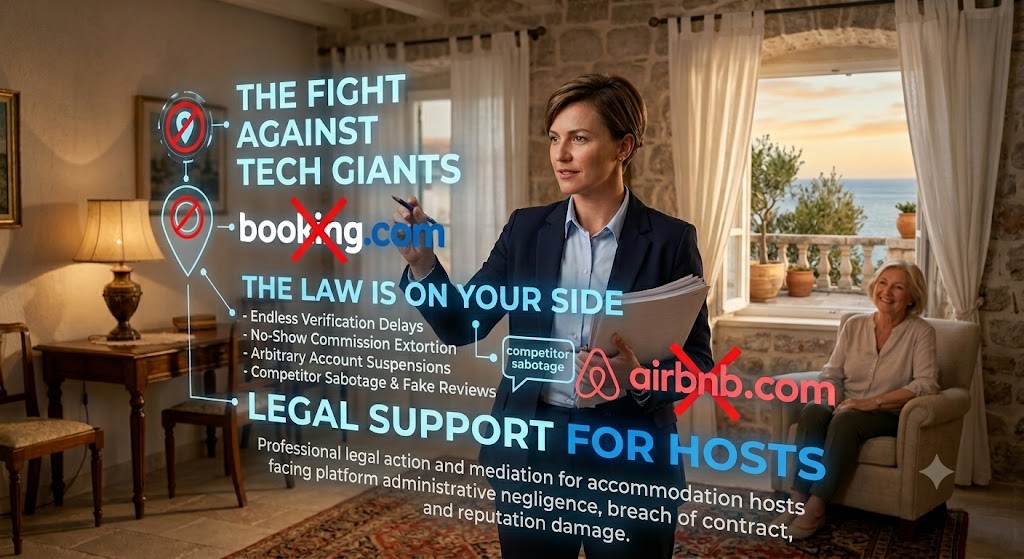
Short-term property rentals (apartment per day) have become one of the most profitable
businesses in the Balkans. However, behind the glowing reviews and fully booked calendars
lies a harsh reality: global tech platforms like Booking.com, Airbnb, and Vrbo hold complete
control over your business.
As an apartment owner (host), you enter into a contractual relationship with these platforms.
But what happens when these platforms unilaterally breach the contract, jeopardize your
livelihood, and cause you direct financial damage?
It is crucial to understand one thing: the automated responses from the support agents of
these platforms do not care about your complaints and explanations, but their legal
teams—against whom we litigate cases—are well aware of the law and fully understand the
legal consequences.
As a law firm that represents property owners in disputes against international and domestic
advertising platforms, we most frequently encounter the following legal issues in our practice:
1. Unjustified Verification Delays and “Hostage” Properties
You have opened your property, prepared for the season, and hired staff, but the platform
keeps you offline for weeks or months under the pretext of “location verification”. In practice,
physical letters sent by mail containing a verification code (verification number) often never
arrive at your address in the Balkans. Even though you have utilized the alternative
methods they prescribe—such as submitting a timely, detailed location verification video and
synchronizing your calendars with other platforms—you continue to receive generic
responses from customer service telling you that “you must wait”.
In doing so, platforms consciously violate all deadlines of their own business policies. While
you regularly pay fixed costs and labor wages, your potential revenue vanishes due to the
platforms administrative negligence, which constitutes direct material damage for which the
platform bears legal liability.
2. Charging Commissions for No-Show Guests
One of the most common issues involves situations where a guest cancels a reservation or
fails to appear (no-show), yet the platform still demands the payment of its commission. As a
host, you are left with no option to appeal through the system ; instead, agents automatically
instruct you that the sole consequence of not paying this unfairly calculated commission is the
permanent termination of your account. Shifting the entire financial burden and risk onto the
host, accompanied by typical threats of shutting down your business, constitutes an abuse of
a monopolistic position and can be successfully challenged legally.
3. Unjustified Account Suspension and Blocking Without Proof
Without any prior warning, the platform’s algorithms can suspend your account overnight,
wiping out hundreds of positive reviews you accumulated over the years. When shutting down
accounts, platforms coldly cite their general delivery terms or specific contractual clauses,
completely ignoring your arguments and evidence. What frustrates hosts the most is the fact
that these platforms take the arguments and arbitrary claims of guests “for granted” without
any material proof, while completely ignoring the legal contractual partner (the host).
Destroying a digital reputation and blocking market access in this manner represents a gross
breach of contractual obligations.
4. Fake Reviews and Sabotage (The Giants “Because We Can” Policy)
Most hosts know that these platforms permit reviews to be left even by no-show guests who
never set foot in the property, as well as consciously allowing fake reservations generated by
unfair competition. When a host reports obvious sabotage and provides undeniable evidence,
customer support usually replies with an automated message stating that “the review
complies with the platform’s guidelines”;. The motto of these massive giants in such cases is
clearly “BECAUSE WE CAN”—they consciously destroy the ratings and reputation of a
legitimate host, absolutely disregarding the evidence and proof of malicious actions
documented by the host.
Is It Possible to Sue Booking.com, Airbnb, and VRBO?
Yes, absolutely. Even though these are multinational corporations headquartered in the
Netherlands (Booking.com), Ireland (Airbnb), or the USA (VRBO), they are not above the law.
Many domestic property owners give up on protecting their rights because they believe they
are "too small" and stand no chance against legal teams from Amsterdam or Dublin. This is a
major misconception. The contracts you sign with these platforms (the so-called General
Delivery Terms) contain clauses that can be challenged in court, particularly when clear
administrative negligence, denial of the right to work, damage to business reputation, or
unjust enrichment at your expense can be proven.
What Does the Legal Protection Process Look Like?
1. Formal Notice: Letter of Intent to Sue: The first and most crucial step we take is
sending an official legal notice on our law firm’s letterhead directly to the platform’s
Legal & Compliance Department. Once the platform receives a document signed and
stamped by an attorney, explicitly outlining the contractual violations and the exact
financial damages incurred, your case is immediately removed from the desks of
regular support agents. Corporate legal teams fully understand the implications of a
lawsuit threat and the risk of accumulating court costs, which is why these issues are
most frequently resolved through expedited procedures.
2. Claim for Material Damages: If your property was unjustifiably blocked during the
season, we legally demand compensation for lost profits (lost projected reservations)
and actual expenses (staff wages, utilities, depreciation) that you incurred while the
property was kept non-functional due to their error.
3. Initiating Court Proceedings: If the platform ignores formal warnings and continues
its practice of jeopardizing your business, we proceed to launch formal legal actions
before the competent authorities.
Do Not Let Your Business Be Held Hostage by Flawed Algorithms and Arrogant
Support
Your apartment is your private property and your personal business. Platforms are merely
intermediaries (advertising services) that take high commissions for their services.
Consequently, they have a legal obligation to provide you with the service you pay for, in
accordance with the contract and the law.
If you are facing months of waiting for location verification, unfair commission charges for
guests who never arrived, fake reviews from competitors, or a blocked account, do not waste
your time and nerves corresponding with customer support robots who constantly tell you to
"do everything through the system".
Contact our law firm so we can review your contract and take immediate, official legal steps
to unblock your property, protect your reputation, and recover the damages you have
suffered.